If you let a property short term in New South Wales, it has to meet the STRA fire safety standard and be listed on the NSW Government's short-term rental accommodation register. That applies whether you list on Airbnb, Stayz, Booking.com or take bookings directly.
The requirements have been in force since 1 November 2021 and are enforced by councils, with penalty notice offences for non-compliance. This guide covers what the standard asks for, which buildings it applies to, and how registration works.
What the fire safety standard requires
The standard is made under the Environmental Planning and Assessment (Development Certification and Fire Safety) Regulation 2021. Older guidance that refers to Division 7D of the 2000 regulation is out of date; the 2021 regulation is the current instrument.
In broad terms, a dwelling used for short-term letting needs:
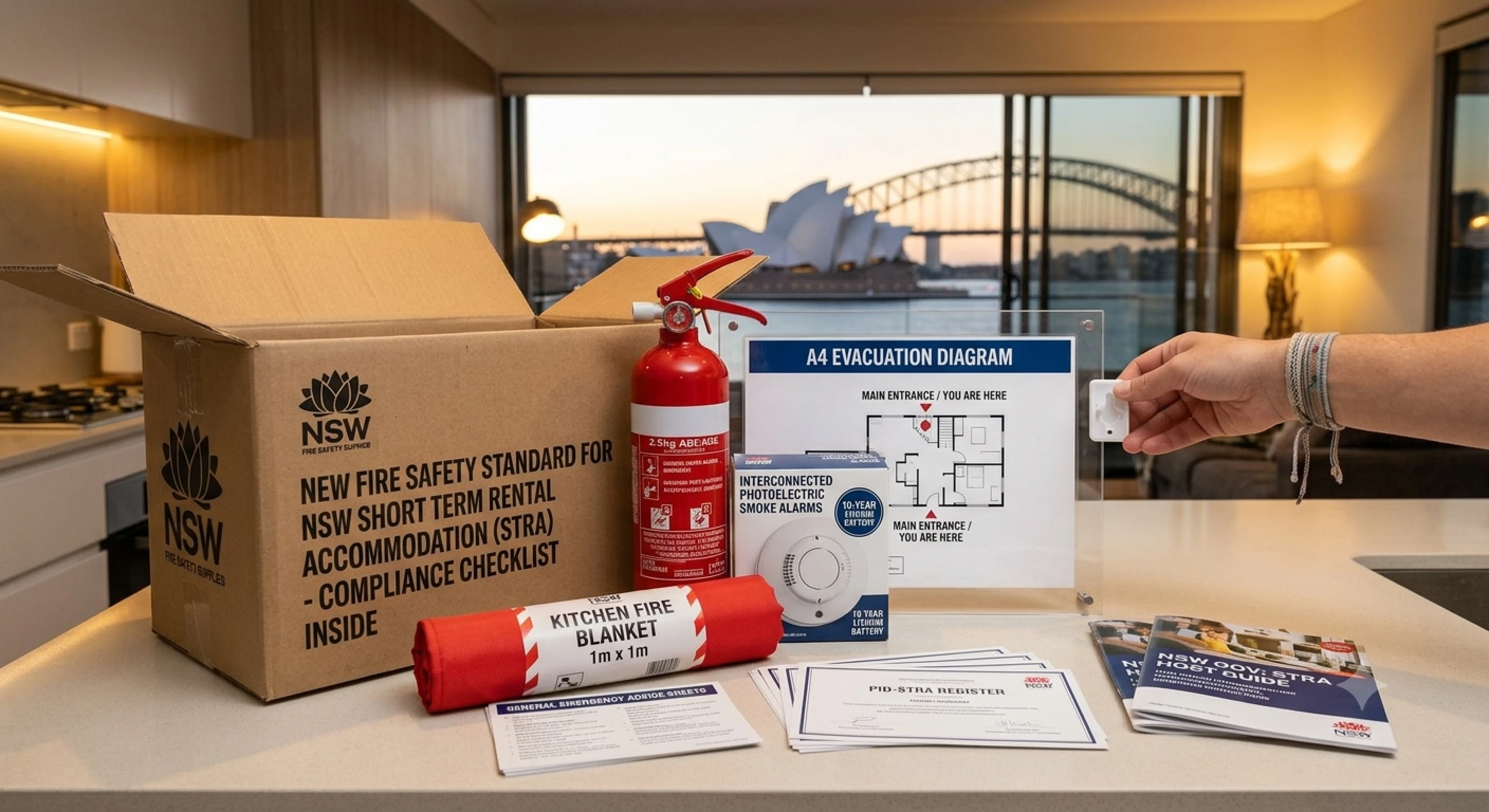
- Interconnected smoke alarms on every storey, in corridors or hallways serving bedrooms, and between the bedrooms and the rest of the dwelling where there is no corridor. Alarms must comply with AS 3786 and be either mains-powered or fitted with a non-removable battery lasting at least ten years. Where there is more than one, they must be interconnected, and wireless interconnection is accepted.
- Heat alarms in a garage sitting beneath habitable rooms.
- An evacuation plan and diagram, displayed on or beside the entrance door, mounted between 1,200mm and 1,600mm above the floor, at least A4, and legible and durable. It should carry the emergency number and point guests to the Emergency+ app.
- Egress doors that open from the inside without a key.
- A fire extinguisher and fire blanket, in the classes where they are required.
The standard itself sets out the detail, including the placement rules. Read it rather than relying on a summary, including this one.
Which buildings it applies to
The National Construction Code groups buildings by how they are used, and the standard applies different requirements to each. Three classes cover almost all short-term rentals.
Class 1a — a standalone dwelling, or one horizontally attached to others: a detached house, terrace, townhouse, duplex or row house.
Class 2 — a multi-unit residential building, typically an apartment block, where each apartment is a sole-occupancy unit. Single-storey attached dwellings can also fall here if they sit above a shared basement or car park.
Class 4 — a sole dwelling inside a building that is otherwise non-residential, such as a residence within a commercial premises. A Class 4 dwelling can sit within a Class 5 to 9 building.
If you are not certain which class applies, that is the first thing to establish, because the requirements differ.
Requirements by class
Class 1a
- Smoke and heat alarms
- Evacuation diagram
Class 2 and Class 4
- Smoke and heat alarms
- Evacuation diagram
- Egress doors that open without a key
- Fire blanket
- Portable fire extinguisher
Registering the property
Registration happens on the NSW Planning Portal. When you register you confirm that you have the owner's consent and that the dwelling meets the fire safety standard, so the compliance work comes first.
- Work out the building class. Class 1a, 2 or 4, as above.
- Meet the requirements for that class. Alarms, evacuation diagram, and where required the extinguisher, blanket and egress door.
- Register on the portal. There is an initial fee and an annual renewal fee. Both are set by the Government and change from time to time, so check the current amounts on the portal rather than relying on a figure quoted elsewhere.
- Record your property ID. Registration issues a PID, which must appear on your listings. The register is integrated with the major booking platforms, which is also how the day limits are monitored.
The register records the number of days a dwelling is let, which matters if your property is non-hosted and subject to a day cap.
Who enforces it
Local councils enforce the standard and handle complaints — a missing smoke alarm or no evacuation information are the common ones. Penalty notice offences apply, so this is not a box-ticking exercise, and it is worth checking the property yourself rather than assuming the last managing agent did.
This is general information, not advice on your particular property. Check the current standard on the NSW Planning Portal, and speak to your council or a qualified fire safety practitioner about anything specific.
If you would rather not manage it yourself, HomeHost handles STRA registration and the fire safety requirements for the properties it manages. Get in touch or call 1300 17 17 18.
Related reading: How to manage the 180-day cap on short-term rentals and Short-term rental insurance in Australia.