The short answer
Before you advertise your Sydney property for short-term rental accommodation — even a single night — NSW law requires you to register it on the NSW STRA Premises Register. Registration is completed through the NSW Planning Portal, takes roughly fifteen to thirty minutes if you have your documents ready, and must be renewed every twelve months. This article walks you through each step as at 1 November 2026.
What the STRA register is and who must be on it
The NSW STRA Premises Register is a state-wide record maintained on the NSW Planning Portal. It exists so that the government, councils and booking platforms can identify every dwelling being used for short-term rental and check that it meets minimum fire-safety and conduct requirements.[1]
Registration is required for two types of STRA use:
- Hosted STRA — you live at the property while guests are staying.
- Non-hosted STRA — guests occupy the whole property while you are absent.
The obligation to register sits with the host or letting agent. If a property manager is arranging the stays and collecting the money on your behalf, they can lodge the registration, but the dwelling details must be accurate and the registration must correspond to your specific premises — one registration per property, not one per host.[1]
Registration does not override zoning, strata by-laws, development approval requirements or council restrictions. It is one layer of compliance, not the whole picture. Check with your solicitor or council if you are unsure whether your property needs development consent before it can be used for STRA.[1]
For non-hosted STRA in Greater Sydney — covering the Eastern Harbour City, Central River City and Western Parkland City — there is also a 180-day cap per year on the number of nights the property can be let. Hosted use is treated differently. The cap applies to actual STRA use, not only to what one platform records.[1]
If you want to understand how registration fits into the broader picture of getting a Sydney property ready to let — including suburbs such as Bronte on the Eastern Suburbs coast or Balmain in the Inner West — the same state rules apply regardless of location.
What you need before you start
Gather the following before you open the Planning Portal. Having everything to hand avoids the session timing out mid-application.
- A NSW Planning Portal account. Create one at planningportal.nsw.gov.au/stra if you do not already have one. You will need a working email address.
- The property address. The registration attaches to the premises, so the address must be exact.
- Accommodation type. Know whether you are registering a house, apartment, terrace, studio or another type.
- Hosted or non-hosted status. Be clear on which applies — this affects the 180-day cap and the fire-safety standard you are declaring against.
- Host name and contact address. The register records these details publicly alongside the dwelling information.
- Fire-safety compliance. Before you can complete registration you must confirm the property meets the applicable fire-safety requirements. See the next section for what that involves.
- Payment method. The registration fee is due at the end of the process. Check the current fee on the NSW Planning page for STRA before you start, as fees may be updated.[1]
If your property was previously registered under a former owner, that registration must be cancelled by them before you can create a new property ID. Coordinate this before settlement if you are buying an already-listed property, because future bookings tied to the old ID may need to be cancelled first.[2]
The registration process
The steps below follow the NSW Planning Portal registration workflow as at 1 November 2026.[2]
Step 1 — Log in and start a new STRA registration
Go to the NSW Planning Portal STRA page and log in to your account. Select Register a STRA property. The portal will generate a reference number immediately — this is a tracking number for the application, not your registration number.
Step 2 — Enter the property details
Provide the dwelling address, accommodation type and whether the use is hosted or non-hosted. Double-check the address: the registration number issued at the end is tied to these details, and errors will need to be corrected before you can list on booking platforms.
Step 3 — Enter host and registrant information
Provide the host's name and contact address. If a letting agent is lodging the registration on behalf of the owner, the portal will ask for registrant details as well. Make sure the information matches what you intend to display or supply to platforms.
Step 4 — Complete the fire-safety declaration
You must confirm that the property complies with the applicable fire-safety standard and describe how it does so. This is covered in more detail in the next section. The registration cannot proceed without this declaration.
Step 5 — Agree to the NSW STRA Code of Conduct
You must acknowledge the Code of Conduct as part of the registration. The Code sets out obligations for hosts, guests and platforms, including complaint and exclusion registers. Read it rather than simply ticking the box — you are legally bound by it once you register.[1]
Step 6 — Pay the registration fee
Pay the applicable fee. The registration is not complete until payment is confirmed.[2] The fee is non-refundable. Check the current amount at the NSW Planning Portal before paying.
Step 7 — Receive your STRA property ID
Once payment clears, the portal issues your STRA registration number (also called the STRA property ID). This number identifies your registered premises in the NSW system. You will need it when you create or update your listing on Airbnb and any other booking platform you use — the platform associates your listing with this registered dwelling.[2]
For a broader look at how registration fits into setting up a Sydney short-term rental, the STRA compliance and fire safety page covers the registration steps alongside the physical safety requirements in one place.
The fire safety declaration
The fire-safety declaration is not a formality. When you tick it, you are confirming that the property actually meets the required standard — and the register must include a description of how the dwelling complies.[1]
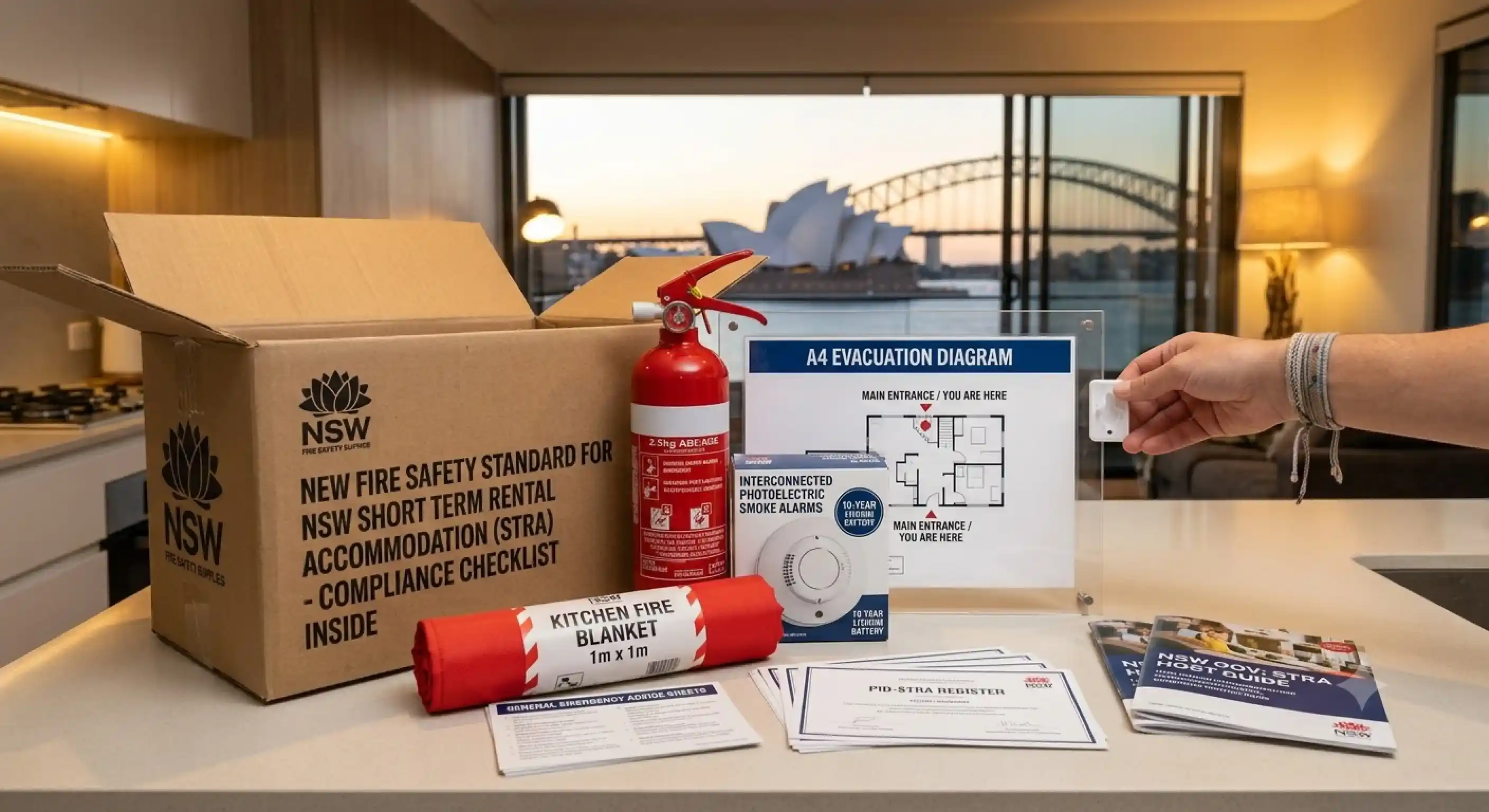
The NSW STRA fire-safety requirements for most residential dwellings include:
- Interconnected smoke alarms — alarms throughout the dwelling that trigger together.
- An evacuation plan posted in the premises so guests know how to exit in an emergency.
- Fire safety equipment appropriate to the dwelling type.
The penalty for using a dwelling for STRA without meeting the fire-safety requirements is up to 150 penalty units for an individual and 300 penalty units for a corporation.[3] The dollar value of a penalty unit can be adjusted by regulation, so check the current NSW penalty-unit value if you need to assess the exposure in dollar terms — do not rely on an older conversion.
Have the smoke alarms tested and the evacuation plan prepared before you attempt to register, not after. If you use a property manager, ask them to confirm what their set-up process covers before you sign a management agreement.
Renewals and keeping it current
Registration lasts for twelve months from the original registration date, not from 1 January each year. Your renewal date is specific to when you first registered.[1]
The Planning Portal sends email reminders at 45 days, 30 days and 7 days before expiry. The renewal window opens 45 days before the expiry date.[1] At renewal you confirm or update the registration information and pay the renewal fee — again, check the current amount on the NSW Planning page as fees may change.[1]
If you miss the renewal deadline, the registration is held for a further three months, but the property must not be used for STRA during that period and online platforms will be blocked from accepting bookings against it. After three months without renewal the registration is automatically cancelled.[2]
You must also notify the Planning Portal of any changes to the registration information — for example, if the property moves from non-hosted to hosted use, or if contact details change. Do not wait for the annual renewal to update material changes.
What happens if you do not register
Providing a dwelling for STRA without a valid registration carries a maximum penalty of 20 penalty units.[3] As with the fire-safety penalties, the dollar amount depends on the penalty-unit value in force at the time of the offence — check the current value through NSW legislation or seek legal advice if you need a dollar figure.
Beyond the fine, an unregistered property cannot be properly listed on platforms that require a registration number. If a booking platform finds that a listing does not have a valid STRA registration number, it can suspend or remove the listing. Operating without registration also exposes you to council enforcement action, which can include orders to stop using the property for STRA.[1]
The practical risk is straightforward: no registration means no legal ability to offer the property for short-term rental, regardless of what your Airbnb listing says.
Questions owners ask
Do I need to display the registration number on my Airbnb listing?
NSW requires registration before advertising. When you create or update your listing on Airbnb or another platform, you will be asked to supply your STRA property ID so the platform can link your listing to the registered premises. Keep the number accessible — you will need it each time you add a new platform or update an existing listing.[2]
Can my property manager register the property on my behalf?
Yes. A letting agent can lodge the registration as the registrant. The property and host details must still be accurate, and the fire-safety declaration is made about the actual condition of the premises. If an agent is registering on your behalf, confirm with them who holds responsibility for keeping the registration current and who receives the renewal reminders.[2]
Does registration cover my whole portfolio, or do I need one per property?
One registration per premises. Each dwelling gets its own STRA property ID, and you must use the correct ID in the advertisement for that specific property. There is no portfolio or bulk registration option.[1]
What if I only want to let the property for a few weeks a year?
The registration requirement applies regardless of how many nights you intend to let. If the property is being offered or used for STRA at all, it must be registered. For non-hosted STRA in Greater Sydney, you can use up to the 180-day cap — but even one night triggers the obligation to register first.[1]
Does registration mean I am approved for STRA under my strata or council rules?
No. Registration and planning or strata approval are separate matters. Your strata scheme may have by-laws that restrict or prohibit short-term letting, and your council may require development consent depending on the property type and local environmental plan. Check both before you register, not after.[1]
I have registered. How do I know what other steps I still need to take?
Registration sits alongside — not in place of — insurance, council requirements, strata rules, income tax obligations and platform terms. Standard home and contents policies generally do not cover short-term letting, so check your policy and ask your broker about specialist short-term rental cover. For tax, the ATO's guidance on rental income applies; speak with your accountant about how to apportion expenses if the property is only let for part of the year. If you want a sense of what your property might earn before committing to a letting strategy, the income calculator takes your suburb, bedroom count and property type and gives you an indicative range — not a guarantee, but a useful starting point.
If you are weighing up short-term against long-term letting, or considering a hybrid arrangement where the property is let short-term for part of the year and on a residential tenancy for the rest, HomeHost's Sydney management page explains how the two models work in practice.
Ready to work through the details for your property? Get in touch and we can go through registration, compliance and letting options with you.
Sources
Related Posts

Proudly partnered with